Douglas Richard Hofstadter (born February 15, 1945) is an American scholar of cognitive science, physics, and comparative literature whose research includes concepts such as the sense of self in relation to the external world,[1][4] consciousness, analogy-making, artistic creation, literary translation, and discovery in mathematics and physics.
===============================
Gödel, Escher, Bach: for Everyone
Anna Heflin
March 27, 2020
Gödel, Escher, Bach: An Eternal Golden Braid by Douglas R. Hofstadter (1979)
Hofstadter’s Pulitzer Prize-winning book, Gödel, Escher, Bach (called GEB for short), is “A metaphorical fugue on minds and machines in the spirit of Lewis Carroll”. It is concerned with the nature of “maps” or links between formal systems and how they apply to the works of mathematician/logician Kurt Gödel, artist M.C. Escher, and of course Bach. This book is dense and is one to revisit throughout the years. Yes, it is complex. However, there is something in it for everyone and the following guide is a list of resources for every reader while diving into GEB. Existing GEB enthusiasts may enjoy the self-referential nature of this article as it’s a guide to guides. All GEB fans old and new have something to learn from the following resources.
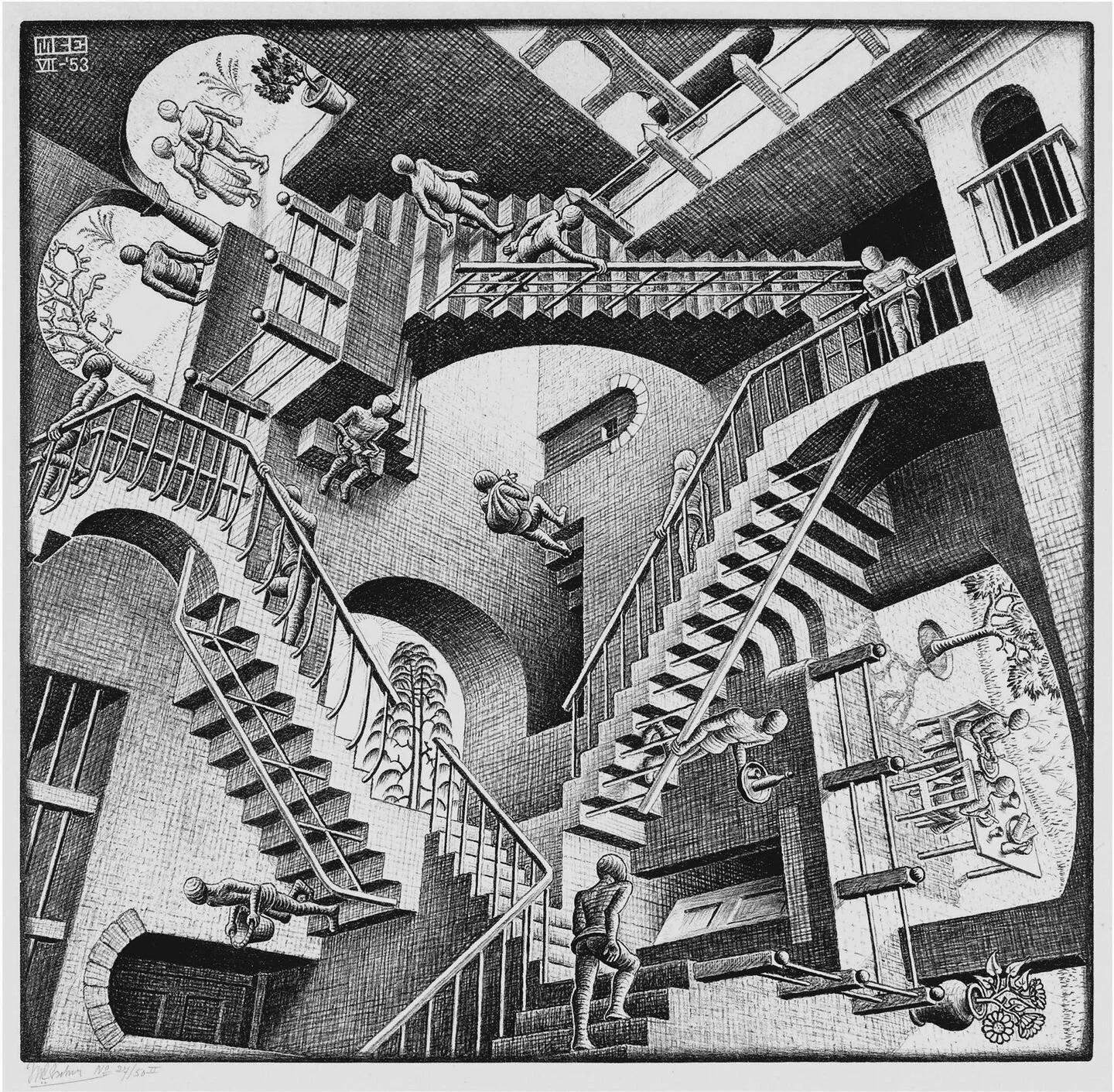
Caption: M.C. Escher’s work Relativity
Listening Guide
This Spotify playlist includes all of the music that is talked about in GEB! It is convenient to keep this playlist open while reading the book.
In 1979, American scientist and author Brian Hayes reviewed GEB for The New York Times. It gives a helpful and succinct overview of the concepts found in GEB.
It’s no coincidence that the writings of Lewis Carroll are an integral part of GEB. Carroll and Hofstadter are writing about the same concepts: paradox, riddles, the impossible, infinite loops, and more. Did you know that Lewis Carroll’s real name was Charles Dodgson and that he was a mathematician? The parallels between these two only begin here.
The Colossal Book of Mathematics collects together Martin Gardner's most popular pieces from his legendary "Mathematical Games" column, which ran in Scientific American for twenty-five years. Topics include GEB, Fractal Music, Time Travel, Games and Decision Theory, Nothing, and Everything.
An entrepreneur lives on the edge and thinks outside of the box. Uma Jayaram explains the relevance of GEB to the journey of an entrepreneur in Godel, Escher, Bach & The Entrepreneur.
Breaking Math Podcast dives into self-referential systems and strange loops in their podcast: Incomplet (GEB: an Eternal Golden Braid: Chapter IV Discussion). They chat about paradox, formal systems, axioms in an accessible and engaging way. For example: If you say all Cretans are false, and you are Cretan: if it’s true then what you just said is false, which then makes it true again. Enjoy these mind-bending paradoxes!