Se afișează postările cu eticheta pictura italiana. Afișați toate postările

miercuri, 30 decembrie 2020

Rafael


Raphael: A celebration of his life and work, on his 500th anniversary

Struck down in his prime, the Italian Renaissance master died on his 37th birthday

================================================================
Raphaël, nom francisé de Raffaello Sanzio (aussi nommé Raffaello Santi, Raffaello da Urbino, Raffaello Sanzio da Urbino), est un peintre et architecte italien de la Renaissance né le 6 avril 1483 à Urbino dans les Marches italiennes et mort le 6 avril 1520 à Rome.

Raphael
Self-Portrait with a Friend
(Double Portrait)
1517-1519

Oil on canvas
Dimensions: 99 x 83 cm (39 x 32 7/10 in.)
Louvre, Paris, France
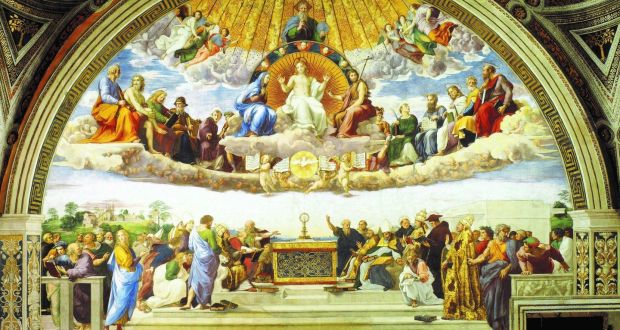
Raphael: a detail from The Disputation of the Holy Sacrament, at the Apostolic Palace

Raphael: a detail from The Disputation of the Holy Sacrament, at the Apostolic Palace


Raphael missed his birthday party in Rome. It was to be the biggest in 500 years, with a year-long celebration and the largest collection of his work assembled in one place. Then Covid-19 struck, just like the mysterious illness which killed the artist on his 37th birthday.

Raffaello Sanzio da Urbino (1483-1520), known to his contemporaries as “the divine Raphael”, was one of the most celebrated artists of the Italian Renaissance. A contemporary of Leonardo da Vinci, 30 years his senior, and Michelangelo, eight years older, the young Raphael learned the rudiments of his trade from his father, Giovanni, a court painter in the duchy of Urbino close to the Adriatic Sea.

When Raphael was eight years old, his mother died and his father remarried a year later. But when Raphael was 11, his father died suddenly, leaving him a flourishing bottegha, or workshop.

In his mid-teens, Raphael collaborated with the celebrated Umbrian master Pietro Vannucci, before moving to Florence in 1504. His career changed dramatically in 1508 when he obtained an audience with Pope Julius II (1503-1513) who commissioned him to paint his private apartments at the Apostolic Palace.
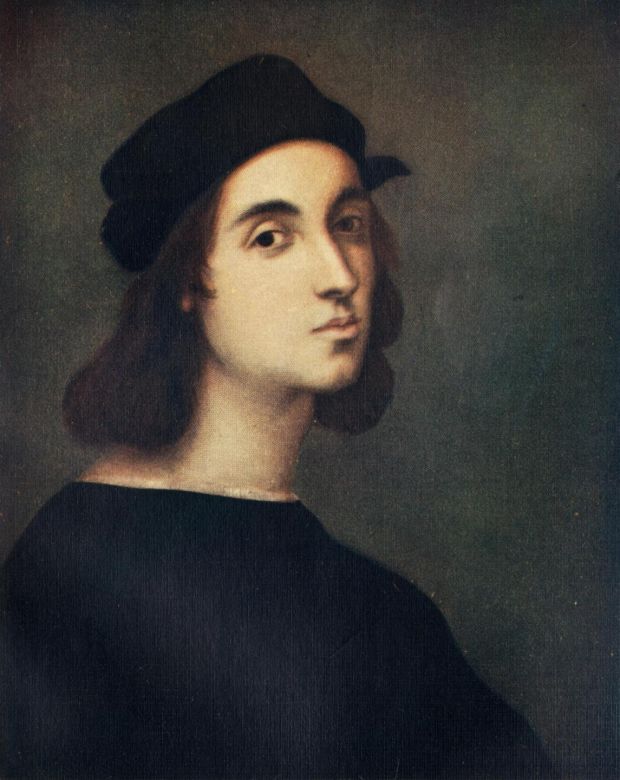
Raphael: a self-portrait that hangs in the Uffizi Gallery, in Florence. Photograph: Print Collector/Getty

In May of that year, Michelangelo began to paint the ceiling of the Sistine Chapel, an enterprise which would occupy him for four years. Meanwhile, Raphael worked nearby decorating the walls of the papal apartments with monumental frescos. Shortly after his arrival, Raphael met Agostino Chigi, the wealthy Sienese banker who commissioned prestigious works and introduced him to influential secular patrons.

Julius had made the Eternal City an enormous workshop, continuing an ambitious building plan launched 30 years earlier by his uncle, Pope Sixtus IV (1471-1484). In 1506, he laid the foundation stone to replace the fourth-century basilica built by the emperor Constantine over the tomb of St Peter.

With the election of Giovanni de’ Medici, son of Lorenzo the Magnificent, as Pope Leo X in March 1513, Raphael’s career was assured. The pope delighted both in the artist’s work and in his company, commissioning him to continue to decorate his private apartments and the adjacent loggia overlooking the city. With the sudden death of Donato Bramante in April 1514, Raphael succeeded him as architect of St Peter’s Basilica.

Having completed the ceiling of the Sistine Chapel in late October 1512, Michelangelo left Rome for Florence, where he worked on the monumental tomb commissioned by Julius several years earlier. Leonardo da Vinci had lived in the Vatican in the early months of Leo’s pontificate but left Rome in 1514. With the departure of both artists, Raphael was the undisputed leader of the Roman Renaissance. There was talk that the pope intended to make him a cardinal.
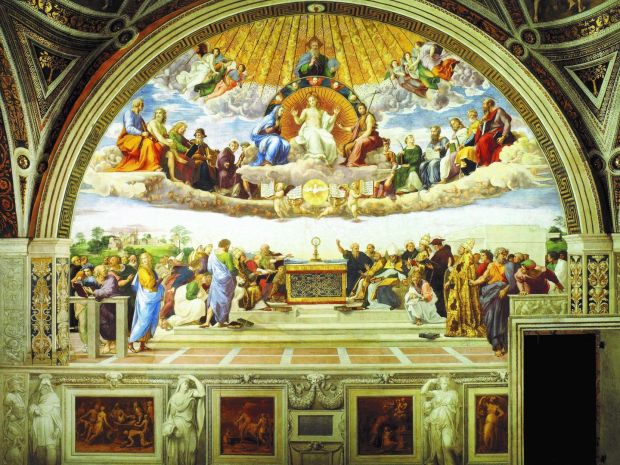
Raphael: The Disputation of the Holy Sacrament, at the Apostolic Palace

When Cardinal Dovizi da Bibbiena offered his niece’s hand in marriage, Raphael politely declined. Perhaps he eyed the possibility of entering the elite group of cardinals from which would come the next pope. He wrote excitedly to his uncle in Urbino, a priest, about his rising fortune, boasting of his wise choice not to accept the cardinal’s niece as his bride.

In the early summer of 1515, Leo commissioned Raphael to design 16 tapestries for the Sistine Chapel, scenes from the life of St Peter and St Paul drawn from the Gospels and the Acts of the Apostles. Leo wanted to outdo his predecessors. As a young man, between 1495 and 1500, he had travelled extensively in northern Europe with his cousin Giulio, the future Pope Clement VII, and had visited several courts.

Tapestries were the most luxurious form of decoration, far more costly than fresco. Woven with expensive wool and silk threads in a variety of hues, highlights were provided by the delicate addition of gold filament. As there was no weaver in Italy capable of producing the large tapestries within a reasonable time, Leo chose the workshop of Pieter van Aelst in Brussels. Raphael prepared a number of enormous drawings made from gouache and pigment and dispatched the cartoons to Brussels in the early summer of 1516.

The Flemish weavers regarded themselves as the finest in the world and regularly altered designs sent to the studio. When Raphael depicted the Risen Christ clothed in a white cloak, the weavers decided to improve the artist’s intention by adding golden stars and a fringe.

The tapestries had to be woven in reverse from the cartoons, each of which was cut into five segments so that all the looms could function simultaneously. When finished, the segments were stitched together and a red border applied to provide a sense of unity.
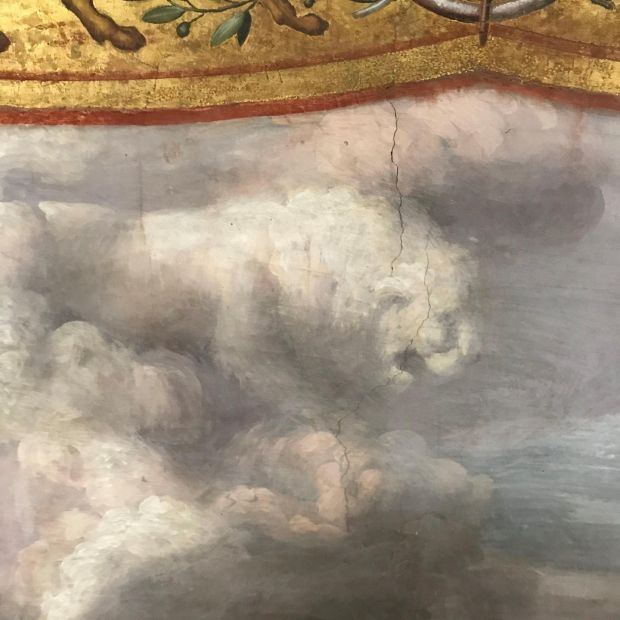
Raphael: clouds in the form of a lion, in the Hall of Constantine, during restoration

While the Flemish weavers worked on Raphael’ s designs, the artist struck an agreement with the engravers Marcantonio Raimondi and Agostino Veneziano to produce copies of the Preaching of St Paul, the Stoning of St Stephen and the Conversion of the Proconsul. These were printed and sold to his admirers.

Raphael almost lost his papal patron when, in the summer of 1517, the 26-year-old Cardinal Alfonso Petrucci and four other cardinals plotted to poison Leo. The cardinal was betrayed by his doctor and was strangled on July 26th in the dungeon of Castel Sant’Angelo, while the other conspirators paid Leo enormous ransoms.

Seven of the tapestries arrived from Brussels in the summer of 1519. Leo was so delighted with the enormous wall coverings that, although the series was not complete, he ordered them to be hung in the chapel on December 26th, the feast of St Stephen.

The papal master of ceremonies Paride de Grassis noted in his diary the pleasure of the papal court as they attended prayers with the pope. If the papal chapel at the Lateran had been described as “no holier place in the world”, then, according to de Grassis, it could be said of the Sistine Chapel: “Now there is nothing in the world more beautiful.” The tapestries were the last large-scale work which Raphael would design for his Medici patron.

While Leo admired the beauty of the tapestries, the Augustinian friar Martin Luther was unravelling the threads of Christendom in Germany.

Raphael was struck down in his prime and, after a brief illness, he died on his 37th birthday, Good Friday, April 6th, 1520. His biographer Giorgio Vasari related, with undisguised admiration, gossip that the painter had expired following a night of passion with one of his favourite female admirers. In fact, the painter had been in bed for two weeks with fever, being patiently bled by his doctors to relieve his poisoned blood. They may have killed him.

Leo was distraught with the news of Raphael’s death. According to his own request, Raphael was buried in the Pantheon, the second-century pagan temple, which had been converted into a church in the seventh century. The funeral took place on Holy Saturday, attended by most of the papal court and thousands of admirers. The unfinished painting of the Transfiguration was carried in the cortege by his distraught Garzoni.
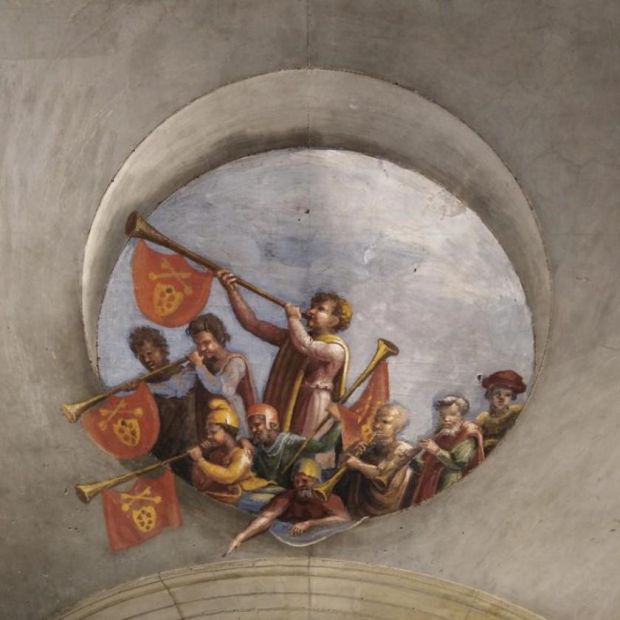
Raphael: a detail from the Hall of Constantine

The year following Raphael’s death, Leo died from pneumonia at the age of 45. His profligacy had bankrupted the papacy and the tapestries were pawned to pay for his funeral.

Shortly before his death, Raphael had commenced the decoration of a large hall in the papal apartments. Having sketched out the main themes, he left his pupils to execute the work. After Raphael’s death, the school spent a further three years concluding the Hall of Constantine.

In 2015, Vatican restorers commenced the task of cleaning the frescos discoloured by almost five centuries of grime caused by oil lamps and pollution. The project was funded by the Patrons of the Arts in the Vatican Museums – New York Chapter and made possible by a generous bequest. Two female faces, painted in oil, were discovered to be in Raphael’s hand. Museum tickets pay for the day-to-day running of Vatican City and gallery expenses while philanthropists fund major restoration projects.

The Vatican has vast, mismanaged wealth mired in financial scandals. Pope Francis has spent the past seven years battling corruption of all types and colourfully referred to the atmosphere there as one of “decomposing fruit”. In October, he removed a cardinal’s voting rights following allegations of embezzlement. The downgraded Cardinal Angelo Becciu held a bizarre press conference last month claiming that his exclusion from the next conclave denied him the right to be elected pope. One feels sorry for Francis.

If some of the artworks at the Vatican were sold, the money could fund charitable projects and administration. While jewels, gold and silverware can be easily disposed of, frescos and encased sculptures are fixed. The Vatican takes a long view, seeing itself as the steward of an unparalleled artistic heritage, guardian of the spiritual attic of civilisation.

Raphael’s World by Michael Collins (Messenger Publications) is available from messenger.ie and from bookshops, €19.95

miercuri, 23 decembrie 2020

Rafael

 https://www.nationalgeographic.com/history/magazine/2020/11-12/renaissance-price-painter-raphael-made-big-impact-short-life/


                                LA BELLE JARDINIÈRE

Also known as The Madonna and Child with the infant Saint John the Baptist, this 1507 work was painted by Raphael during his time in Florence and is one of his best-loved Madonnas. Louvre, Paris.

The Renaissance 'Prince of Painters' made a big impact in his short life

Peer to Michelangelo and Leonardo, Raphael produced many masterpieces before dying at age 37. His influence has only grown in the 500 years since his untimely death.

RENAISSANCE ITALY WAS a time of ruthlessness in politics and exquisite sensibility in art and culture, two extremes that shaped the life and art of Raffaello Sanzio, better known to the world today as Raphael. Younger than Michelangelo and Leonardo da Vinci, whose influences he absorbed—and then matched—Raphael was a great Renaissance artist of harmony, proportion, and grace.

Although his masterpieces served the naked power politics of the day, and were commissioned by influential churchmen, bankers and a pope, they were also infused with tenderness and subtlety. The 16th-century painter and biographer Giorgio Vasari wrote in his Lives of the Most Excellent Painters, Sculptors, and Architects: “Most artists have hitherto displayed something of folly and savagery . . . In Raphael, on the other hand, the rarest gifts were combined with such grace, diligence, beauty, modesty and good character that they would have sufficed to cover the ugliest vice.”

Newly arrived in Florence and in his early 20s, Raphael painted this self-portrait in tempera on wood between 1504 and 1506. Uffizi Galleries, Florence

By 1508 the young artist, already well-known in Florence for the brilliant Madonnas he had painted there, received a fateful summons from Pope Julius II: a commission to paint his Vatican apartments. The series of masterpieces that he created in these four staterooms, including “The Disputation of the Holy Sacrament,” and “The School of Athens,” forged Raphael’s fame as the “prince of painters.” His talent for clear storytelling through complex grouping, gesture, and color celebrated Catholic orthodoxy, pagan mythology, and humanist scholarship, linking all the tensions and glories of his age.

First steps of a master

Raphael was born in Urbino in northeastern Italy in 1483, the only surviving child of Magia di Battista Ciarla and Giovanni Santi, a painter in the court of the Duke of Urbino. Under the duke’s patronage, the city-state was a hub of cultural activity, and the duke could count the brilliant painter and mathematician Piero della Francesca among his courtiers.

Raphael’s parents both passed away when he was a child. His mother died in 1491. Before his father’s death in 1494, his father, whom Vasari described as an undistinguished painter, imparted the rudiments of painting to his son at an early age. The boy’s extraordinary talent was evident.

Raphael was sent to study in the workshop of Perugian artist Pietro Perugino when he was a boy. Perugino was admired for his mastery of perspective, a technique on display in his 1481 painting “Delivery of the Keys.” Perugino’s work depicts the moment Christ hands the keys of the kingdom of heaven to St. Peter. The carefully arranged scene takes place in a large square with the lines of perspective converging in the central doorway in the background.

Left: Delivery of the Keys (detail), by Pietro Perugino, 1481. Sistine Chapel, Vatican Museums
Right: 

The Marriage of the Virgin, by Raphael, 1504. Pinacoteca di Brera, Milan

ALBUM / FINE ART IMAGES (LEFT) AND SCALA, FLORENCE (RIGHT)

Unsurprisingly, Raphael’s early paintings bear the strong imprint of his teacher. The 1504 painting “The Marriage of the Virgin,” for a chapel of the Albizzini family in the church of San Francesco al Prato, in Città di Castello, shows clear similarities with the earlier painting by Perugino. It too takes place in a Renaissance square. Two groups in the foreground flank the central characters, the Virgin Mary and Joseph, who is placing a ring on her finger. Space and perspective are built up by the figures in the square behind, receding in size, and, as with Perugino’s painting, the lines of perspective converge on the doorway of the church. (This audacious artist shocked 17th-century Italy with her work.)

Behind the groom stand Mary’s other suitors who all carry sticks. Joseph also holds one, but his is blooming. Raphael’s work illustrates a popular legend. According to the story, Mary presented sticks to all her suitors, telling them that she would marry the one whose blossomed, a sign of divine favor.

Raphael was not merely content with perfecting the perspectival relations between the figures; he also used their positioning to create a complex harmony. There is nothing haphazard or accidental about their placement: Beauty, to Raphael, was about calculation and artifice, “making things not as Nature makes them, but as Nature should.”

Florentine flair

The next phase of Raphael’s life would be marked by building on all he had learned in Perugia and blending it with new influences to create his own distinctive visual style. Key to this process would be exposure to the great masters working at the time. Raphael traveled first to Siena and then to Florence, the epicenter of Renaissance painting. Vasari wrote that on arrival in Florence, Raphael “was no less delighted with the city than with the works of art there, which he thought divine, and he determined to live there for some time.”

The two principal talents who shaped Raphael during this crucial phase were Leonardo da Vinci and Michelangelo, who were creating some of their best works in the early 1500s. Both men were older than Raphael (Leonardo by 31 years and Michelangelo only by eight), and Raphael adopted and modified their techniques. From Leonardo, he mimicked both Leonardo’s pyramid-shaped compositions and his use of sfumato, a technique that relies on soft, fine shading rather than harsh lines.

The Madonnas painted by Raphael in his Florentine period were influenced by Leonardo’s 1503 work “The Virgin and St. Anne,” which depicts a lamb held by the Christ Child as his mother Mary embraces him. The Virgin is, in turn, seated on the lap of her mother, St. Anne. The figures form a pyramid, and their complex interactions influenced several of Raphael’s Florentine Madonnas, which feature multiple figures, including “La Belle Jardinière” (“The Beautiful Gardener”). (Why Leonardo da Vinci’s brilliance endures, 500 years after his death.)

With Michelangelo, Raphael not only observed how accurate rendering of human anatomy could reveal the sublime, he also became engaged in one of art history’s greatest rivalries. Michelangelo did not care for Raphael at all; some art historians attribute his ill will stemming from losing a commission to the younger artist in 1508.

THE DEPOSITIONAlso known as The Borghese Entombment, oil on board, 1507. Borghese Gallery, Rome

Michaelango's influence can be seen in Raphael’s 1507 work, “The Deposition,” which shows the lifeless body of Christ being borne to his tomb. The Virgin Mary, in blue veil, faints from the agony of her loss. The anatomy, weight, and positioning of the figures, especially the kneeling woman before the Virgin, are reminiscent of those in Michelangelo’s works such as the “Doni Tondo” and the unfinished “Battle of Cascina.”

Roman triumph

Raphael beat both Leonardo and Michelangelo to secure a commission from Pope Julius II to create frescoes at the Vatican. The young artist relocated to Rome and began work around 1508.

Michelangelo was working on the ceiling of the Sistine Chapel during this time, and art historians believe that the two artists’ competitive relationship drove both their works to greater heights. Completed in 1511, Raphael’s four frescoes on the walls of the Stanza della Segnatura, the papal library, are among his finest works, especially “The School of Athens,” which many regard as his masterpiece. The work contains depictions of 50 philosophers, including Plato, Aristotle, Socrates, Ptolemy, Euclid, Averroes, and Hypatia of Alexandria.

THE SCHOOL OF ATHENSSome 50 thinkers from the past form a colorful group in Raphael’s 1509-1511 masterpiece, “The School of Athens.” Commissioned for Pope Julius II’s Vatican library, the composition centers on Aristotle and Plato, with the latter modeled on Leonardo da Vinci. Heraclitus of Ephesus, the solitary figure leaning on a block, is believed to be a portrait of Michelangelo.

Art historians believe that Raphael used his contemporaries as inspiration for his figures. The central figure of Plato, who points to the sky, is modeled after Leonardo da Vinci. A lone, brooding figure sits in the foreground, his head resting on his hand. Many believe this bearded figure is Michelangelo. Raphael also placed himself in the portrait at the far right. He stands next to Zoroaster (who holds a celestial sphere) and Ptolemy who holds a globe. (See where Leonardo da Vinci still walks the streets.)

Renaissance Christians believed that the great humanist ideas of the past were completed and perfected by Christ, and the fresco Raphael painted directly across from “The School of Athens” displays that theme of theology. “The Disputation of the Holy Sacrament” acts as a mirror and counter-weight to philosophy, with similar composition and palette, but different focal points. The upper part of the painting is the kingdom of heaven centered on Jesus Christ, the Virgin Mary, and St. John the Baptist. Above them in a golden realm sits God the Father and the angels.

THE DISPUTATION OF THE HOLY SACRAMENTFresco, ca 1509-1510, Vatican Museums

Below them on Earth, theologians and popes debate the miraculous properties of the Sacrament contained in the vessel on the altar. Echoing the composition of “The School Of Athens,” the groupings are complex and interrelated, but unlike the great philosophy painting, the theologians are not depicted inside a building, but outside in nature below a bright blue sky. (The painter behind 'Birth of Venus' invented a new kind of art.)

Raphael would continue to work at the Vatican by himself and with apprentices to create frescoes for other papal chambers. He also took on private commissions, including portraits, and architecture. Pope Julius’s banker, Agostino Chigi, commissioned Raphael’s design of his funerary chapel in the church of Santa Maria del Popolo in 1513. After Pope Julius II’s death in 1513, his successor, Leo X, continued working closely with the talented Urbino painter. He appointed Raphael as director of the building works at St. Peter’s when Donato Bramante, the original architect, died in 1514. In 1515 the pope commissioned designs from Raphael for 10 massive tapestries that would hang in the Sistine Chapel. (This Renaissance warrior woman defied powerful popes.)

Earthly pleasures

Raphael spent the rest of his life in Rome. He founded his own studio and employed as many as 50 artists and pupils to work with him on his new commissions. He never married nor had children. Vasari wrote that Raphael might have been delaying marriage because he believed a future appointment as cardinal could be coming from the pope.

"La Fornarina" ("The Baker's Daughter"), by Raphael, oil on board, 1518-19. Barberini Palace, Rome

Despite this reasoning, Raphael did develop a reputation as a ladies’ man. Vasari wrote that “Raffaello was a very amorous person, delighting much in women,” including courtesans. According to tradition, Raphael’s great love was Margherita Luti, a baker’s daughter and almost certainly the model for Raphael’s beautiful portrait “La Fornarina,” painted in 1518-1519. He was also known for his intensely creative friendships, especially with the diplomat and scholar Baldassare Castiglione, the subject of one of Raphael’s most engaging portraits.

In 1517, rich and successful, Raphael bought the Palazzo Caprini in Rome, where he died on Good Friday, 1520. Vasari attributed Raphael’s death to sexual overindulgence, hinting at venereal disease, but the true cause of death is unknown. Raphael was laid to rest in the Pantheon. His epitaph reads: “Here lies Raphael. Living, great Nature feared he might outvie Her works; and, dying, fears herself may die.”